Most lift incidents don’t begin at working height. They begin earlier, while the arms are still moving and the pads are still being positioned. That brief setup window is where habits show up, and where small decisions carry the most weight.
Arm placement isn’t a new conversation in the shop, and that familiarity is exactly why it deserves another look. Vehicle designs have changed. Wheelbases are longer. Underbodies are more complex. Electric vehicles add new constraints around contact points and weight distribution. Precision during setup matters more now than it did a decade ago.
Two-post lifts bring that increased risk into sharp focus. They remain the most versatile lifting solution in many service bays, but when fundamentals are rushed and arm placement is off, the lift doesn’t have a way to correct the error.
Taking the time to choose the right lifting points in the beginning is the only way to ensure proper loading and lifting. For guidance, reference the Automotive Lift Institute (ALI) Safety Decals and your ALI Vehicle Lifting Points Guide.
When Early Errors Compound
Mistakes made during setup don’t stay small. Improper arm placement is a high-consequence error because it affects stability as soon as load begins to transfer. A vehicle can shift nose-heavy or tail-heavy in inches, not feet. What starts as a routine raise can quickly turn into a slide, a tip, or a sudden drop.
That’s what makes these incidents so dangerous. They don’t require unusual conditions or extreme misuse. They happen during everyday jobs when placement is assumed instead of verified. The risk isn’t theoretical. A falling vehicle creates a crushing hazard with no margin for recovery.
Near misses reinforce the point. A vehicle that shifts or settles without falling is not a success—it’s a warning that the setup was wrong and the outcome could have been far worse with one person standing in the wrong place.

Precision during setup matters more now than it did a decade ago
Common Spotting Errors Technicians Encounter
In most cases, incidents trace back to the same avoidable setup shortcuts:
- Guessing at lifting points instead of using OEM-recommendations
- Leaving pads slightly off-center rather than fully centered under the lifting point
- Not checking adapter engagement or using the wrong interface for trucks and SUVs
- Skipping the bumper/stability test and going straight to working height None of these are complex mistakes. They’re rushed ones.
Why Two-Post Lifts Magnify Small Setup Errors
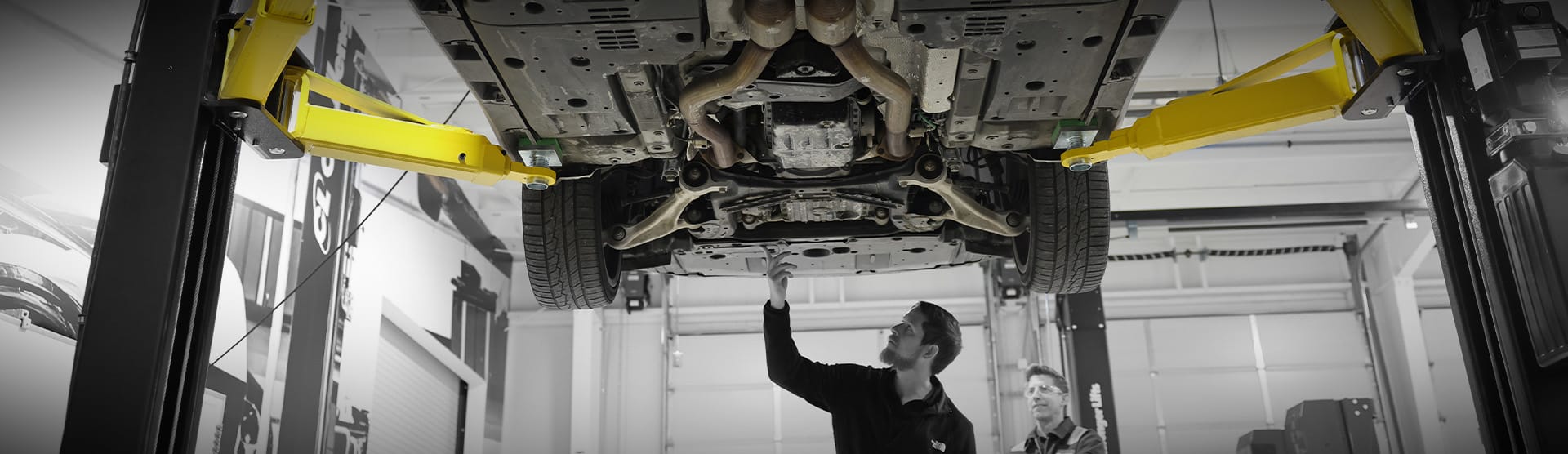
Two-post lifts support the vehicle entirely through four contact points. That design delivers excellent access, but it also demands accuracy. If the arms are mispositioned or the load isn’t balanced between columns, there’s no forgiveness once the vehicle leaves the floor.
This risk increases when the vehicle’s center of gravity is altered by cargo or fuel. When removing components after lifting, keep in mind that there will likely be a change to load distribution, and support stands should be used.
Safety while using two-post lifts depends greatly on technician judgment during spotting, because even the smallest setup errors can amplify quickly.

If the arms are mispositioned or the load isn’t balanced between columns, there’s no forgiveness once the vehicle leaves the floor
Fundamentals That Keep the Vehicle Stable
Preventing lift incidents comes down to following a consistent setup process every time a vehicle is spotted:
- Identify manufacturer-specified lifting points before positioning arms
- Position arms based on lift rated load capacity and vehicle center of gravity
- Use the correct adapters and pad extensions for vehicle type and frame height
- Raise the vehicle just off the floor and perform bumper/stability test, repositioning immediately if movement is detected
- Raise to working height and lower onto mechanical locks
This is the difference between repetition and discipline, and it’s sometimes decided before you ever hit the raise button.
Engineering Safeguards Built into the Lift
Training builds judgment, but equipment design should reinforce it. Challenger Lifts approaches arm placement as both an operator responsibility and an engineering challenge.
Mechanical arm restraint systems are designed to prevent arm movement between the fully lowered position and engagement with the vehicle lifting point. Arm stop hardware prevents over-extension and potential damage. Abiding by OEM pickup points and having clear per-arm load ratings help reinforce the importance of even weight distribution.
Operating procedures emphasize raising the vehicle slightly and verifying stability before committing to full height. These steps are purposefully built into how Challenger Lifts expects the equipment to be used.
Stability Before Working Height
Full load transfer is the point where the vehicle’s weight has fully shifted off the shop floor and onto the lift arms and adapters and is supported entirely by the lift. That moment is where safety is decided. Treat those first seconds as a technical operation, not a routine step. Place the arms with intent. Center the pads, confirm stability, then lift.